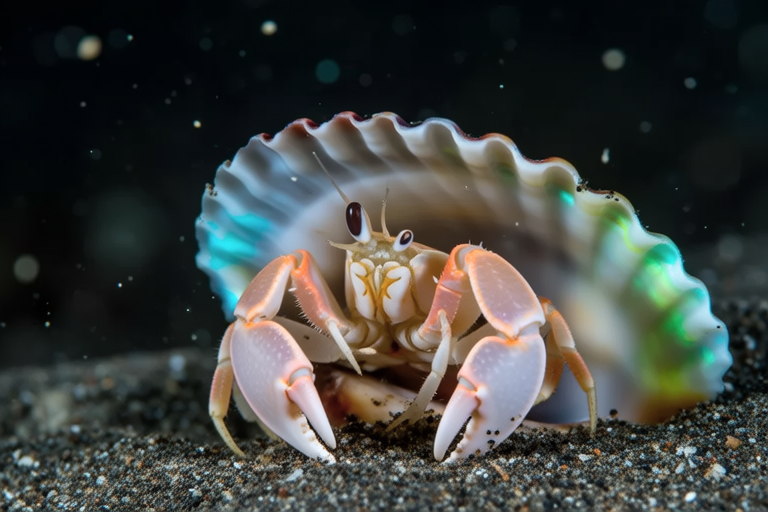
Adorable Yet Unknown: Discover the Life Inside a Pea Crab Host
In the vast ocean, where countless species coexist in intricate relationships, one of the most fascinating and lesser-known partnerships is that between pea crabs and their hosts, typically bivalves like oysters or mussels. These tiny crustaceans have adapted to live inside their hosts, forming a symbiotic relationship that benefits both parties. This article delves into the world of pea crabs, exploring their unique adaptations, life cycles, behaviors, and the ecological significance of their relationship.
The Symbiotic Relationship
The symbiotic relationship between pea crabs and their hosts is mutually beneficial. Pea crabs, scientifically known as Pinnotheridae, are small crabs that live inside the mantle cavity of bivalves. The host provides protection, shelter, and nutrients, while the pea crab helps in cleaning the host’s gills and filtering out harmful substances. This mutualism ensures the survival of both species in the challenging marine environment.
Unique Adaptations
Pea crabs have evolved several remarkable adaptations to thrive within their hosts. Their flattened bodies and soft shells enable them to fit snugly inside the narrow spaces of bivalve shells. Additionally, they possess long, slender legs that help them move around inside the host without causing damage. These adaptations not only protect the pea crabs from predators but also ensure they can efficiently navigate the confined space.
Life Cycle and Behaviors
The life cycle of pea crabs begins with the release of larvae into the water column. Once the larvae find a suitable host, they enter through the bivalve’s gills or mantle cavity. After entering, they undergo metamorphosis, transforming into juvenile crabs. As they mature, pea crabs continue to reside within the host, growing to full size and eventually reproducing inside the same host. Mating occurs internally, with males transferring sperm to females. Once fertilized, the female lays eggs within the host, and the cycle repeats.
Pea crabs exhibit interesting behaviors to maintain their symbiotic relationship. They actively participate in cleaning the host’s gills, removing debris and parasites. This cleaning behavior not only benefits the host but also provides food for the pea crabs. Additionally, pea crabs have been observed engaging in gentle movements within the host, which may help stimulate water flow and improve the host’s respiration.
Challenges Faced by Pea Crabs
Despite the advantages of living within a host, pea crabs face several challenges. One major challenge is competition for resources within the limited space. Multiple pea crabs may reside in a single host, leading to potential conflicts over food and mating opportunities. Another challenge is the risk of being ejected by the host if it perceives the pea crabs as harmful. To mitigate this, pea crabs have developed mechanisms to avoid detection, such as blending in with the host’s tissues or producing chemical signals that mimic those of the host.
Scientific Insights
Research has provided valuable insights into the relationship between pea crabs and their hosts. Studies have shown that the presence of pea crabs can enhance the health and growth of their hosts by reducing the burden of parasites and improving respiratory efficiency. Additionally, genetic analysis has revealed that some species of pea crabs have evolved to specialize in certain host species, demonstrating the complexity and specificity of these symbiotic relationships.
Examples of Different Species
Several species of pea crabs exist, each with specific host preferences. For instance, Pinnixa fabulosa is commonly found in Pacific coast oysters, while Pinnixa granulata prefers Atlantic coast clams. Other species, such as Pinnixa littoralis, inhabit various bivalves along the eastern coast of North America. Each species has adapted to its particular host, showcasing the diversity and adaptability of pea crabs in different marine environments.
The Importance of Understanding Micro-Habitats
Understanding the micro-habitats within marine organisms, such as the symbiotic relationship between pea crabs and their hosts, is crucial for marine conservation efforts. These relationships play a vital role in maintaining the balance of marine ecosystems. By studying and protecting these interactions, we can better understand the overall health and resilience of marine environments.
Moreover, the knowledge gained from studying pea crabs can be applied to other areas of marine biology and ecology. It provides valuable insights into the evolution of symbiotic relationships and the adaptations necessary for survival in diverse environments. This understanding can inform conservation strategies and management practices, ensuring the preservation of marine biodiversity.
Conclusion
The symbiotic relationship between pea crabs and their hosts is a testament to the complexity and beauty of marine ecosystems. These tiny creatures have adapted to live within the confines of bivalves, forming mutually beneficial partnerships that enhance the health and survival of both species. By delving into the lives of pea crabs, we gain a deeper appreciation for the intricate web of life in the ocean and the importance of preserving these delicate relationships for future generations.
