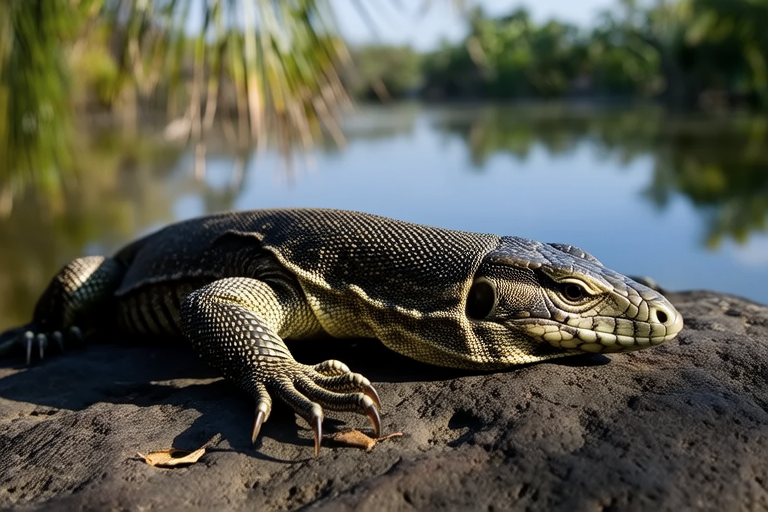
Top 10 Fascinating Facts About the Elusive Water Monitor
The water monitor (Varanus salvator) is one of the largest lizards in the world, known for its agility, intelligence, and adaptability. Found across Southeast Asia, these creatures have captured human imagination for centuries, appearing in local folklore and mythology. This article delves into ten fascinating facts about the water monitor, offering a blend of scientific insights, behavioral observations, and historical context.
1. The Largest Lizard in the World
The water monitor can grow up to 3 meters in length, making it one of the largest lizards globally. Males tend to be larger than females, with some specimens reaching impressive weights of over 50 kilograms. Their size is a testament to their evolutionary success, allowing them to dominate their environment and prey on a wide range of animals. This remarkable growth is facilitated by their diet, which includes small mammals, birds, fish, and even other reptiles. Studies have shown that the water monitor’s ability to consume large quantities of food at once contributes significantly to its growth rate.
2. Unique Physical Adaptations
Water monitors possess several physical adaptations that make them well-suited for both aquatic and terrestrial environments. Their powerful tails help them swim efficiently through water, while sharp claws enable them to climb trees and dig burrows. Additionally, they have long tongues used for detecting chemical signals in the air, enhancing their hunting capabilities. These lizards also boast a highly efficient circulatory system that helps regulate body temperature, crucial for maintaining optimal metabolic rates in varying climates.
3. A Diverse Diet
Water monitors are opportunistic feeders, consuming a wide variety of prey items depending on availability. Their diet primarily consists of small mammals, birds, fish, amphibians, and insects. They also scavenge carrion when necessary, demonstrating remarkable adaptability. In coastal areas, water monitors have been observed feeding on mollusks and crustaceans, further expanding their dietary repertoire. Researchers suggest that this diverse diet plays a significant role in their survival and reproduction.
4. Extensive Habitat Range
Native to Southeast Asia, water monitors inhabit a vast array of habitats from mangrove swamps and riverbanks to grasslands and forests. They are particularly adept at thriving in disturbed environments, often being found near human settlements where food is abundant. Despite their adaptability, specific microhabitats such as termite mounds and tree hollows provide essential shelter and breeding sites. Conservation efforts focus on protecting these critical areas to ensure the survival of the species.
5. Interaction with Humans
Water monitors have coexisted with humans for millennia, playing important roles in local cultures and economies. In many regions, they are revered as symbols of strength and resilience, featuring prominently in traditional stories and ceremonies. Some communities view them as beneficial pest controllers, helping to maintain ecological balance by controlling rodent populations. However, due to habitat destruction and hunting pressures, interactions between water monitors and humans have become increasingly challenging.
6. Intelligent Behavior
Water monitors exhibit high levels of cognitive function, displaying problem-solving abilities and social behaviors. Observational studies reveal that they can learn from experience and use tools to obtain food. For instance, individuals have been observed using sticks to probe crevices for hidden prey. Such intelligence suggests complex neural structures underlying their behavior, warranting further research into their cognitive capacities.
7. Historical Context
Water monitors have been part of human history since ancient times, appearing in various forms of art and literature. Ancient civilizations, including those in India and China, depicted these lizards in religious texts and architectural designs. Over time, they became integral to cultural practices, symbolizing power, protection, and wisdom. Today, water monitors continue to inspire awe and curiosity among people around the world.
8. Myths and Legends
In numerous Asian cultures, water monitors hold special significance, often appearing in myths and legends. One popular tale from Malaysia tells of a giant water monitor capable of transforming into a human warrior during battles. Another story from Indonesia recounts how a benevolent water monitor protected villagers from floods by blocking river channels with its massive body. These narratives reflect the deep connection between people and nature, highlighting the importance of preserving natural heritage.
9. Conservation Status
Despite their widespread distribution, water monitors face threats from habitat loss, illegal trade, and climate change. Populations in certain regions are declining rapidly, prompting conservation organizations to implement measures aimed at safeguarding their future. Efforts include establishing protected areas, enforcing stricter regulations on wildlife trafficking, and promoting sustainable land-use practices. Public awareness campaigns emphasize the need for responsible stewardship of biodiversity.
10. Scientific Research
Ongoing scientific investigations aim to deepen our understanding of water monitor biology and ecology. Recent studies focus on genetic diversity, population dynamics, and disease prevalence within different subpopulations. Researchers employ advanced technologies such as GPS tracking devices and camera traps to monitor movement patterns and assess habitat preferences. These findings contribute valuable data towards developing effective management strategies.
In conclusion, the water monitor remains an enigmatic creature, combining physical prowess with intellectual acumen. As we strive to protect this magnificent species, let us draw inspiration from its resilience and adaptability, embracing our shared responsibility to preserve Earth’s rich tapestry of life.
