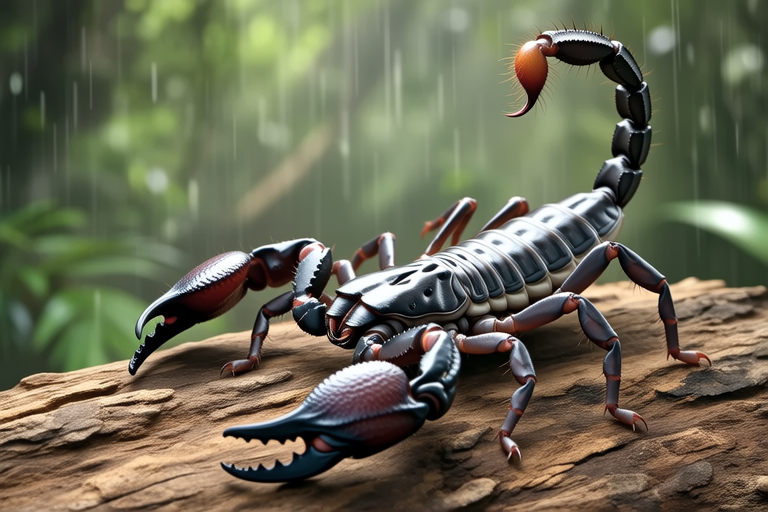
The Heterometrus Spinifer: A Fascinating Journey into the World of Exotic Scorpions
Scorpions are among the most fascinating creatures on Earth, with their ancient lineage and diverse adaptations making them a subject of both scientific inquiry and popular fascination. Among the many species of scorpions, the Heterometrus spinifer stands out as a particularly intriguing specimen. This article delves into the unique characteristics, habitat, behavior, and myths surrounding the Heterometrus spinifer, providing a comprehensive look at this remarkable arachnid.
Unique Characteristics
The Heterometrus spinifer, commonly known as the Malaysian forest scorpion, is a member of the family Scorpionidae. It is distinguished by its robust build and distinctive appearance. Adult Heterometrus spinifers can reach lengths of up to 12 centimeters, making them one of the largest scorpion species found in Southeast Asia. Their coloration typically ranges from dark brown to black, which serves as effective camouflage in their natural habitats.
One of the most striking features of the Heterometrus spinifer is its formidable tail, known as the metasoma. The tail is equipped with a venomous stinger at its tip, used primarily for defense against predators. The venom of the Heterometrus spinifer contains a cocktail of neurotoxins that can cause pain, swelling, and localized numbness in humans. While the sting is painful, it is rarely life-threatening, and antivenom is available in areas where the scorpion is common.
Another notable characteristic is the presence of spines on the legs, which gives the species its name. These spines are thought to aid in capturing prey and navigating through dense vegetation. The Heterometrus spinifer’s pincers, or pedipalps, are also well-developed and play a crucial role in subduing prey and handling food.
Habitat and Distribution
The Heterometrus spinifer is native to tropical regions of Southeast Asia, including Malaysia, Thailand, and Indonesia. It thrives in humid, forested environments, often found in leaf litter, under logs, and within crevices of rocky outcrops. The scorpion’s preference for moist, shaded areas underscores its adaptation to the hot, tropical climate of its habitat.
These scorpions are highly adaptable and can survive in a variety of conditions, from dense rainforests to more open, grassy areas. They are nocturnal creatures, spending their days hidden from the sun and emerging at night to hunt for food. Their ability to thrive in diverse environments has contributed to their widespread distribution across Southeast Asia.
Behavior
Like other scorpions, the Heterometrus spinifer is primarily solitary and territorial. Males engage in elaborate mating dances to attract females, which involve a complex series of movements and signals. Once a male and female have mated, the female will carry the eggs internally until they hatch. After hatching, the young scorpions remain on their mother’s back for several days before dispersing.
The diet of the Heterometrus spinifer consists mainly of insects, spiders, and other small invertebrates. They are opportunistic hunters, relying on their keen sense of touch and vibration detection to locate prey. Once a potential meal is detected, the scorpion uses its powerful pincers to grasp and immobilize the prey, injecting venom through its stinger if necessary.
Despite their fearsome reputation, Heterometrus spinifers are generally docile and prefer to avoid confrontation. They will only resort to using their stinger as a last resort when threatened or cornered. In captivity, these scorpions can be kept as pets, provided their specific environmental needs are met.
Myths and Mysteries
Throughout history, scorpions have been surrounded by myths and superstitions, often portrayed as symbols of evil and danger. The Heterometrus spinifer is no exception, with local folklore attributing magical properties to the creature. Some believe that the venom of the Heterometrus spinifer has healing powers, while others claim that the scorpion’s sting can cure certain ailments.
While these beliefs may lack scientific backing, they highlight the cultural significance of the Heterometrus spinifer in Southeast Asian communities. Scientific research continues to unravel the mysteries surrounding this scorpion, with studies focusing on the composition of its venom and its potential applications in medicine.
Comparisons with Similar Species
The Heterometrus spinifer shares many similarities with other large scorpion species found in Southeast Asia, such as the Heterometrus laoticus and Heterometrus longimanus. However, there are key differences that set the Heterometrus spinifer apart.
For instance, the Heterometrus spinifer is generally larger and more robust than its relatives, with a more pronounced tail and stronger pincers. Its preferred habitat also differs, with the Heterometrus spinifer favoring denser, more humid environments compared to other species that may inhabit drier, more open areas. Additionally, the venom of the Heterometrus spinifer has distinct chemical components that differentiate it from the venom of other scorpion species.
These differences underscore the importance of accurate identification and classification in scorpion biology. Understanding the unique characteristics of each species is crucial for both scientific research and conservation efforts.
Conservation Status
As with many species, the conservation status of the Heterometrus spinifer is a matter of concern. Habitat destruction due to deforestation and urbanization poses a significant threat to the survival of these scorpions. Additionally, the pet trade has led to over-collection in some areas, further reducing wild populations.
Efforts to conserve the Heterometrus spinifer and its habitat are underway, with organizations working to protect critical ecosystems and raise awareness about the importance of biodiversity. Captive breeding programs have also been established to help maintain healthy populations of these scorpions outside of their natural environment.
Conclusion
The Heterometrus spinifer is a remarkable species with unique characteristics, behaviors, and cultural significance. From its formidable appearance to its role in local folklore, this scorpion captivates both scientists and enthusiasts alike. By understanding and appreciating the Heterometrus spinifer, we can work towards ensuring its continued existence in the wild and preserving the rich biodiversity of Southeast Asia.
As we continue to explore the world of exotic animals, the Heterometrus spinifer serves as a reminder of the incredible diversity of life on our planet and the importance of conservation efforts to protect it.
